
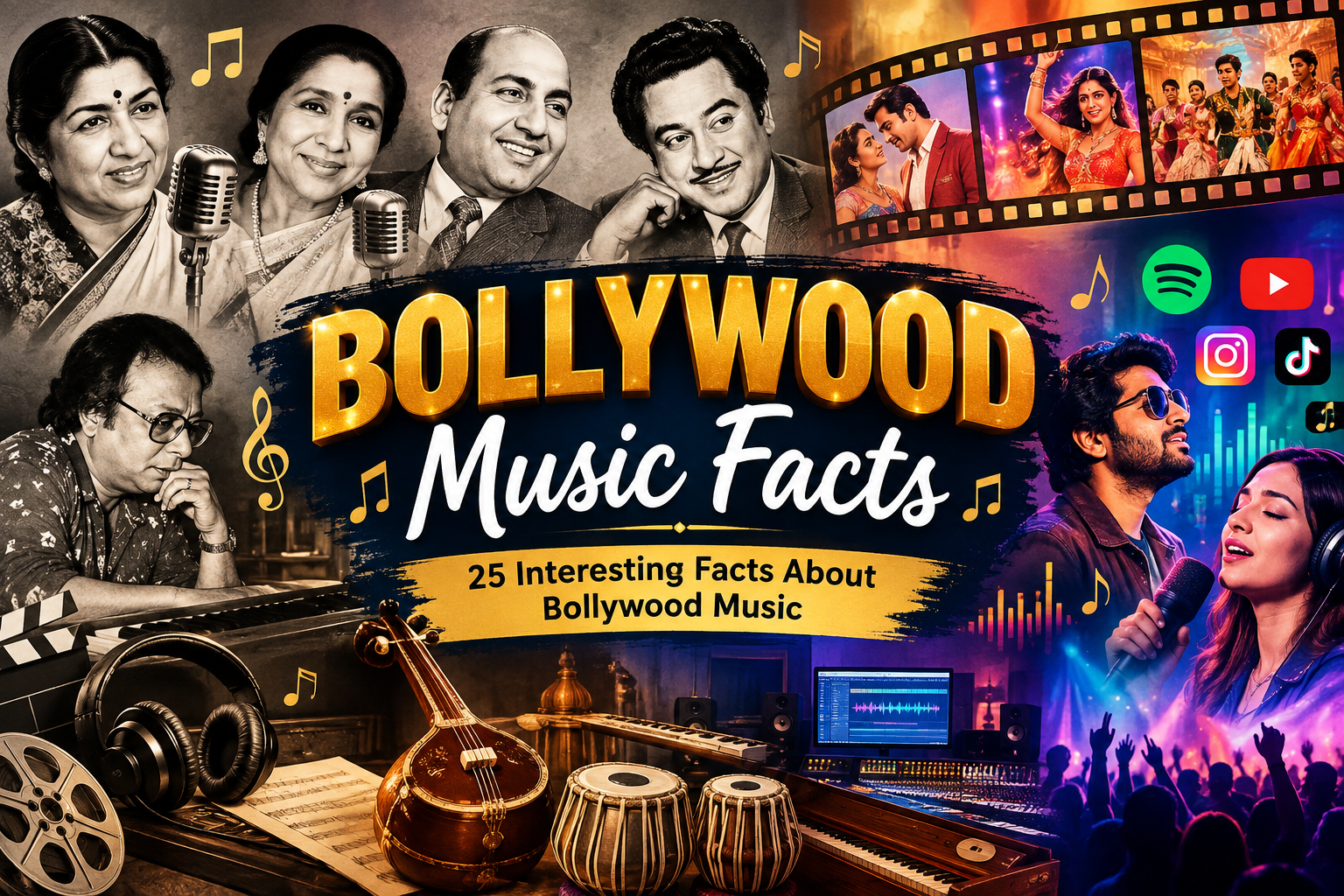
Bollywood music is one of the most recognizable parts of Indian popular culture. For generations, Hindi film songs have entertained audiences with romantic melodies, emotional ballads, energetic dance numbers and unforgettable musical performances. From classic black-and-white movies Bollywood Music Facts to today’s digital releases, Bollywood music has continuously changed while maintaining its strong connection with listeners.
There is much more to Hindi film music than simply adding songs to a movie. Behind every memorable track are singers, composers, lyricists, musicians, arrangers, producers and sound engineers who work together to create the final recording.
In this article, we explore some fascinating Bollywood Music Facts, including the history of playback singing, the influence of Indian classical music, legendary singers, changing technology and the way audiences discover Hindi songs today .
1. Bollywood Music Has a Long History
The history of Bollywood music goes back to the early era of Indian talkies. Once films began using synchronized sound, songs quickly became an important part of Hindi cinema.
Early Indian movies often featured actors singing themselves. As the film industry developed, specialized playback singers became increasingly important.
Over the decades, Hindi film music developed its own identity by combining Indian musical traditions with influences from around the world.
2. Playback Singing Changed Hindi Cinema
One of the most important Bollywood Music Facts is the rise of playback singing.
In playback singing, a professional singer records the song separately. The actor then performs the song on screen while the recorded vocal track is used in the film.
This system allowed filmmakers to select singers based on their vocal qualities rather than requiring every actor to be a professional singer.
Playback singers eventually became major stars themselves. Their voices became closely associated with some of the biggest actors and characters in Hindi cinema.
3. Lata Mangeshkar Became a Legendary Voice
Lata Mangeshkar is one of the most influential playback singers in Indian music history.
Her career lasted for several decades, and her voice became associated with numerous generations of Hindi film actresses.
Her recordings helped establish the importance of the female playback voice in Bollywood and influenced generations of singers who followed.
4. Asha Bhosle Expanded the Possibilities of Playback Singing
Asha Bhosle is another iconic name in Bollywood music.Oxford Academic – Bollywood Sounds
Known for her versatility, she performed songs across numerous styles and genres. Her repertoire included romantic songs, energetic dance numbers, cabaret-inspired tracks and classical-influenced compositions.
Her ability to adapt to different musical styles is an important part of Bollywood’s rich musical history.
5. Mohammed Rafi Had an Exceptionally Versatile Voice
Mohammed Rafi became famous for his ability to perform songs in very different emotional and musical styles.
He recorded romantic songs, classical compositions, devotional music, patriotic songs and energetic numbers.
His versatility allowed filmmakers to use his voice for a wide range of characters and situations.
6. Kishore Kumar Was Both a Singer and Actor
Kishore Kumar was not only a famous playback singer but also an actor, filmmaker and entertainer.
His distinctive voice became particularly associated with romantic and expressive songs.
His work remains popular among listeners, and many of his songs continue to be played on radio, television and digital streaming platforms.
7. Bollywood Music Draws From Indian Classical Music
Indian classical music has had a significant influence on Hindi film songs.
Composers have used melodic ideas, rhythms and instruments associated with classical traditions while creating accessible music for mainstream audiences.
Some songs are strongly influenced by classical traditions, while others combine classical elements with pop, folk or Western musical styles.
This mixture has helped Bollywood develop a sound that can be both traditional and contemporary.
8. Folk Music Is Another Major Influence
Indian folk music has also contributed heavily to Bollywood.
Different regions have their own musical traditions, instruments and rhythms. Bollywood composers have frequently adapted or drawn inspiration from these traditions.
Punjabi, Rajasthani, Bengali and other regional influences can be heard across Hindi film music.
This regional diversity is one reason Bollywood music can sound so different from one song to another.
9. Lyrics Are Essential to Bollywood Songs
A Bollywood song is not only about melody and vocals. Lyrics are also extremely important.
Lyricists create words that can express love, heartbreak, friendship, celebration, patriotism and many other emotions.
Hindi and Urdu poetry have had a particularly strong influence on the language and style of Bollywood songwriting.
Some songs have become memorable primarily because listeners connect strongly with their lyrics.
10. Bollywood Has Used Many Musical Genres
There is no single Bollywood sound.
Over the decades, Hindi cinema has featured classical music, ghazals, qawwali-inspired compositions, disco, rock, pop, hip-hop, electronic music and folk-inspired songs.
Different periods have produced different musical trends.
The disco era, for example, introduced a distinctive dance-oriented sound, while later decades saw increasing use of electronic production and international pop influences.
11. Music Can Help Tell a Movie’s Story
Songs often perform a storytelling function in Bollywood films.
A song can introduce a relationship, reveal a character’s emotions, show the passage of time or provide information about a character’s dreams and feelings.
This is different from simply using music as background sound.
In many Hindi films, songs become important narrative moments that audiences remember independently of the movie itself.
12. Bollywood Music Has a Huge Global Audience
Hindi film music has listeners far beyond India.
Indian communities around the world have helped Bollywood songs become popular at weddings, cultural events, celebrations and parties.
Streaming services have expanded this international reach even further by allowing listeners to discover Hindi music without needing access to traditional Indian media.
13. Technology Has Completely Changed Music Production
Recording technology has transformed Bollywood music.
Earlier recordings often required musicians to perform together, with fewer opportunities for extensive editing.
Modern digital recording allows vocals and instruments to be recorded separately. Producers can edit, mix and master individual elements before creating the final track.
Digital technology has therefore given composers and producers much greater flexibility.
14. The Orchestra Once Played a Huge Role
Large orchestras were an important part of many classic Bollywood recordings.
Numerous musicians could be involved in creating the arrangement, including string players, percussionists, wind instrumentalists and players of traditional Indian instruments.
Modern production can create many sounds digitally, but live musicians continue to contribute to Bollywood and Indian music.
15. Bollywood Songs Can Become Bigger Than Their Movies
Sometimes a song becomes more popular than the movie in which it appears.
A memorable melody, dance performance or emotional lyric can give a song a life of its own.
Listeners may know and enjoy a song without having watched the complete film.
This is one reason Bollywood music has such a strong independent identity within Indian entertainment.
16. Dance Songs Are an Important Part of Bollywood
Dance numbers have become a defining feature of mainstream Hindi cinema.
These songs often combine strong rhythms, memorable hooks and elaborate choreography.
They can become major cultural moments when audiences recreate the choreography at weddings, parties and social events.
Modern dance songs frequently incorporate elements of hip-hop, electronic music, Punjabi beats and international pop.
17. Bollywood Music Keeps Rediscovering Older Songs
Older Bollywood songs continue to attract new listeners.
Streaming platforms, playlists and social media have introduced classic songs to younger audiences.
In addition, recreated versions of older songs are frequently used in contemporary films and music releases.
This creates a connection between different generations of listeners.
18. Remixes Have Become Popular
Remixes and recreated versions have become an important part of modern Indian popular music.
A producer may use a recognizable melody or hook from an older recording and combine it with a contemporary arrangement.
This approach can introduce classic melodies to younger listeners, although discussions about originality and artistic interpretation often accompany recreated songs.
19. Independent Artists Are Changing the Music Landscape
Bollywood remains extremely influential, but listeners today have many alternatives.
Independent Indian artists can release music directly through digital platforms and social media without needing their songs to appear in a movie.
This has created a broader Indian music ecosystem where film music, independent releases and regional music exist alongside one another.
20. Streaming Has Changed How People Discover Songs
Music streaming has made discovery much easier.
Listeners can create playlists, receive recommendations and explore artists from different decades and languages.
A classic Bollywood song can appear alongside a newly released track, allowing different generations of music to reach the same audience.
21. Social Media Can Revive Older Songs
Social media has created new opportunities for older Bollywood music.
A song recorded decades ago can suddenly become popular again when it appears in a viral video, dance trend or online meme.
This means the popularity of a song is no longer necessarily tied to the year in which its movie was released.
22. Bollywood Music Is a Collaborative Art
A successful song usually involves many creative professionals.
The composer develops the music, the lyricist writes the words and the singer performs the vocal. Musicians, arrangers, producers and sound engineers then contribute to the final production.
The finished track is therefore the result of collaboration rather than the work of one person alone.
23. Music Directors Have Helped Define Different Eras
Different generations of composers have introduced different sounds to Hindi cinema.
From orchestral and classical arrangements to disco, pop, electronic music and contemporary fusion, music directors have responded to changing audience tastes.
Their work has helped shape the musical identity of different periods of Bollywood.
24. Bollywood Music Continues to Mix Tradition and Modern Sounds
Modern Hindi film music frequently combines traditional Indian instruments and melodies with contemporary production.
A single song might include Indian percussion, electronic sounds, Western instruments and modern vocal processing.
This fusion allows Bollywood music to maintain connections with its past while appealing to modern audiences.
25. Bollywood Music Is Still Evolving
Perhaps the most important of all Bollywood Music Facts is that Hindi film music is constantly changing.
New technology, streaming platforms, social media, independent artists and global musical influences are creating new opportunities for composers and singers.
At the same time, classic Bollywood melodies continue to remain popular.
This combination of tradition and innovation is one of the defining characteristics of Indian film music.
Conclusion
These Bollywood Music Facts demonstrate how much history, creativity and technology exist behind Hindi film songs. From the rise of playback singing and legendary voices to modern streaming and social media, Bollywood music has continuously evolved.
Its strength comes from its ability to combine different musical traditions while responding to changing audiences. Classical music, folk traditions, Western influences, pop, hip-hop and electronic production have all contributed to the development of Hindi film music.
For music lovers, Bollywood offers an enormous collection of songs to explore—from timeless classics to contemporary releases. As technology and listening habits continue to change, Bollywood music will likely keep developing new sounds while preserving the melodies and traditions that made it popular in the first place.
[…] this article, we explore some interesting Music Industry Facts, including the growth of streaming, the role of copyright, music royalties, independent artists, […]